
Command & Control
Operational Command Architecture
Effective defense and security operations depend on the ability to collect, process, and act on information in real time. SSME provides command and control (C2) architectures designed to unify sensor data, communication networks, and decision-support tools into a single operational framework that gives commanders a clear, actionable picture of their domain.
Our C2 solutions are built on C4I-ready principles — Command, Control, Communications, Computers, and Intelligence — providing the technological backbone for coordinated multi-domain operations. Whether operating from a permanent security operations center or a forward-deployed mobile command station, SSME architectures deliver the sensor fusion, data visualization, and secure communications that modern operations demand.
Each command and control deployment is engineered to integrate with the client's existing infrastructure, sensor networks, and communication systems. The result is an operational environment where data flows seamlessly from field sensors to command displays, enabling faster and better-informed decision-making at every level of the chain of command.
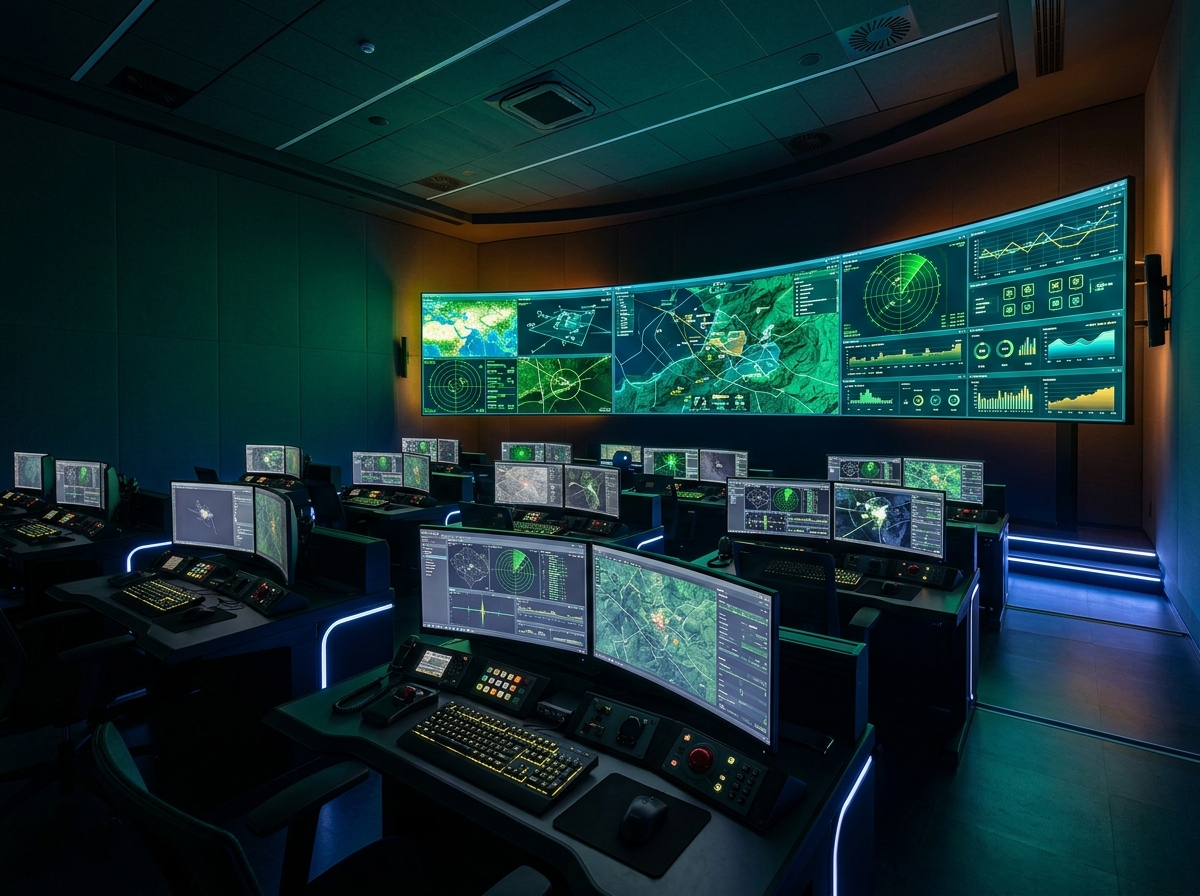
Command & Control Technology Stack
Six integrated capabilities form the operational foundation of SSME command and control architectures, from real-time dashboards to mobile deployment platforms.
Situation Awareness Dashboards
Real-time operational dashboards display a unified common operating picture, consolidating data from all connected sensors, cameras, and field units into intuitive map-based and tabular displays. Operators can monitor status, track assets, and view alerts across the entire operational domain from a single interface.
Multi-Sensor Fusion
Sensor fusion engines correlate data from radar, RF detection, EO/IR cameras, ground sensors, and UAV feeds into a single coherent picture. By combining inputs from multiple sensor types, the system eliminates redundant tracks, reduces false positives, and provides enriched target intelligence that no single sensor can deliver alone.
Real-Time Decision Support
Decision-support modules provide automated alerts, threat assessment overlays, and predictive analytics that help operators evaluate situations rapidly. Configurable rule sets trigger notifications based on predefined criteria such as perimeter breach, airspace intrusion, or pattern-of-life anomalies, accelerating the decision-to-action cycle.
Mobile Command Stations
Vehicle-mounted and containerized mobile command stations bring full C2 capability to forward positions, temporary deployments, and remote operational areas. These self-contained units include displays, communication equipment, power systems, and environmental control, allowing command operations to deploy wherever the mission requires.
Secure Communication Networks
End-to-end encrypted communication channels ensure that command directives, sensor data, and intelligence are transmitted securely between command centers, field units, and remote assets. Network architectures support redundant pathways and failover mechanisms to maintain connectivity even in degraded conditions.
Mission Data Visualization
Advanced visualization tools present operational data through geo-referenced map layers, timeline views, trend analysis charts, and event replay functions. Commanders can review historical data, analyze patterns, and generate reports for after-action review, operational planning, and compliance documentation.
Unifying Defense & Security Operations
SSME command and control architectures serve as the operational nerve center, integrating with counter-UAS, UAV/ISR, and security infrastructure systems to provide a single unified command environment.
Counter-UAS Integration
The C2 platform receives real-time detection, tracking, and classification data from counter-UAS sensors, displaying drone threats on the common operating picture alongside other security feeds. Operators can authorize response actions directly from the command interface, maintaining a complete audit trail of all decisions.
View Counter-UASUAV/ISR Integration
UAV ground control stations connect to the C2 architecture, feeding live video, flight telemetry, and sensor data into the operational picture. Commanders can task UAV assets, redirect surveillance routes, and coordinate aerial operations with ground-based security units from a single command position.
View UAV & ISRSecurity Systems Integration
Perimeter sensors, access control systems, CCTV networks, and alarm panels feed into the C2 platform, providing a comprehensive security picture. Operators can correlate events across multiple security layers, manage incidents from detection through resolution, and generate unified security reports.
View Security SolutionsUnderstanding Command & Control
What is command and control in defense?
Command and control (C2) in defense refers to the exercise of authority by a designated commander over assigned forces to accomplish a mission. It encompasses the personnel, equipment, communication systems, facilities, and procedures used to plan, direct, coordinate, and control operations. Modern C2 systems integrate digital technologies including situation awareness displays, sensor fusion engines, decision-support tools, and secure communication networks to provide commanders with a real-time operational picture. C4I — Command, Control, Communications, Computers, and Intelligence — extends this concept to include the full technology infrastructure required for multi-domain, multi-echelon operations. SSME provides C2 and C4I-ready architectures for defense, homeland security, and critical infrastructure operators across KSA, GCC, and Africa.
Command & Control FAQ
What is a C2 system in defense?
A C2 (Command and Control) system is the integrated framework of personnel, equipment, communications, and procedures that enables a commander to plan, direct, and coordinate operations. In modern defense environments, C2 systems are digital platforms that consolidate sensor feeds, communication channels, and intelligence data into a unified operational display. This gives decision-makers real-time visibility over their entire area of responsibility, enabling faster and more informed responses to threats and operational situations.
What is sensor fusion and why does it matter?
Sensor fusion is the process of combining data from multiple sensor sources — such as radar, cameras, RF detectors, and ground sensors — into a single coherent operational picture. Without fusion, operators must monitor multiple independent displays, mentally correlating data and increasing the risk of missed detections or delayed responses. Sensor fusion automates this correlation, deduplicating tracks, enriching target data with information from multiple sources, and presenting operators with a cleaner, more accurate, and more actionable picture of the operational environment.
Can SSME C2 systems integrate with existing infrastructure?
Yes. SSME command and control architectures are designed with open interfaces and standard communication protocols that enable integration with existing security systems, sensor networks, and communication infrastructure. During the planning phase, SSME conducts a thorough assessment of installed systems, communication pathways, and data formats to define the integration approach. This ensures that legacy investments are preserved while new C2 capabilities enhance and unify the overall operational picture without requiring a complete infrastructure replacement.
What is a mobile command station?
A mobile command station is a self-contained, transportable C2 facility that provides full operational capability in the field. Typically housed in a vehicle or containerized shelter, mobile command stations include situation awareness displays, communication equipment, power generation, environmental control systems, and network connectivity. They are used for forward-deployed operations, temporary security events, disaster response, and any scenario where command capability must be established rapidly at a location that lacks permanent infrastructure.
Discuss Your Command & Control Requirements
Whether you are building a new operations center, upgrading an existing C2 platform, or deploying mobile command capability for field operations, our team will assess your requirements and design an architecture that unifies your operational picture.