
Security & Critical Infrastructure
Comprehensive Protection for Critical National Assets
Critical infrastructure — from airports and energy facilities to government buildings and maritime ports — forms the backbone of national security and economic stability. These assets face an evolving spectrum of threats that demands comprehensive, multi-layered security architectures capable of detecting, deterring, and responding to intrusions across physical, aerial, and electronic domains.
SSME designs and delivers integrated security solutions tailored to the specific threat profile, regulatory framework, and operational requirements of each protected site. Our approach combines perimeter defense systems, surveillance networks, access control platforms, counter-drone capabilities, and command-and-control integration into unified security architectures that provide operators with a complete view of their security posture.
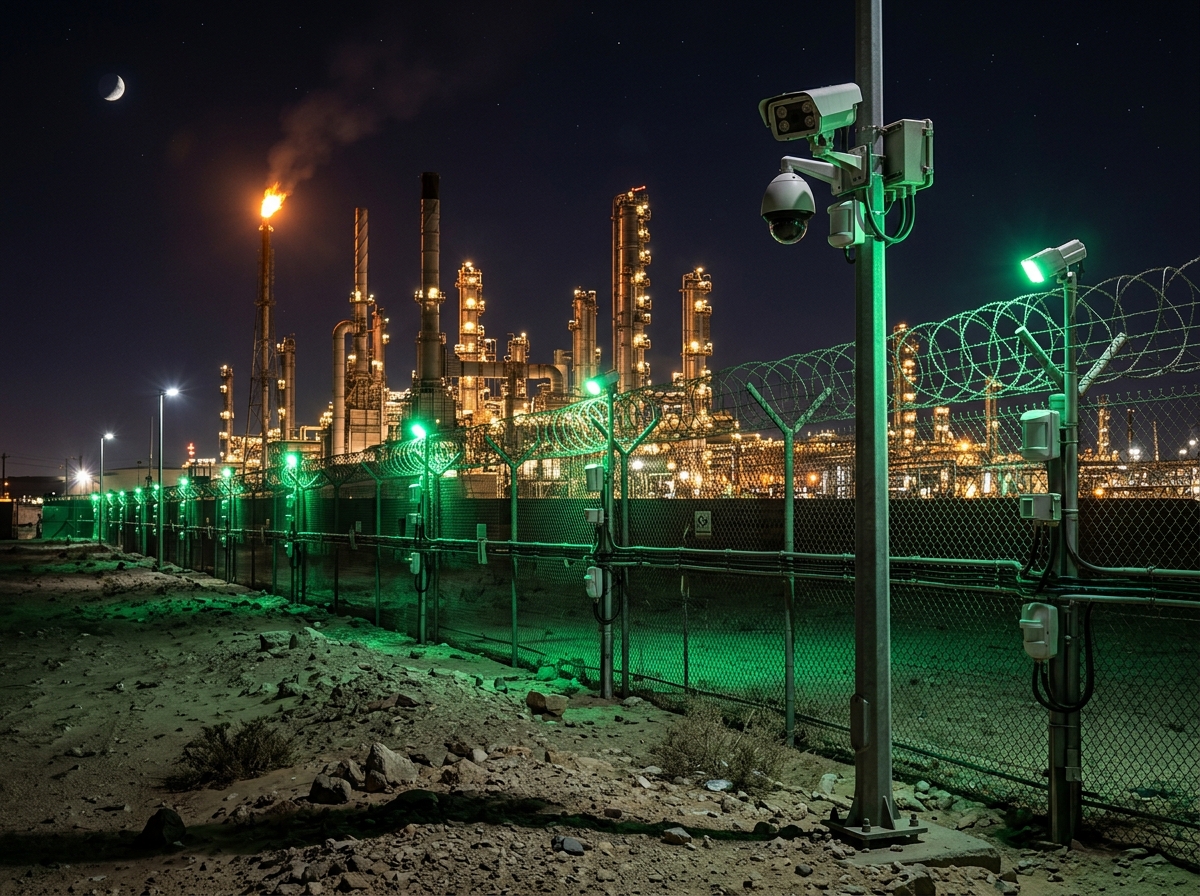
Every security deployment is engineered for the operational environment — whether protecting a sprawling petrochemical complex in the desert, securing a coastal port facility, or providing temporary security for a large-scale public event. SSME works within applicable regulatory frameworks and procurement procedures to deliver solutions that meet the highest standards of operational readiness.
Infrastructure-Specific Security Solutions
Each sector presents unique vulnerabilities, regulatory requirements, and operational constraints. SSME configures security architectures to address the specific challenges of each environment.
Airports & Aviation
Comprehensive airside and landside security including perimeter intrusion detection, counter-drone protection for controlled airspace, terminal surveillance, and integration with air traffic management and civil aviation security protocols.
Oil & Gas Facilities
Perimeter surveillance and protection for refineries, processing plants, pipeline corridors, tank farms, and offshore platforms. Solutions address sabotage threats, unauthorized access, aerial surveillance, and the unique safety requirements of hazardous environments.
Ports & Maritime
Port perimeter security, vessel tracking, waterside intrusion detection, and maritime domain awareness. Solutions comply with ISPS Code requirements and integrate with vessel traffic management systems to secure commercial and naval port operations.
Government Sites
Multi-layer security for government ministries, administrative complexes, and diplomatic facilities. Solutions include access control, visitor management, surveillance, counter-surveillance measures, and integration with national security communication networks.
Military Bases
Force protection architectures for military installations encompassing perimeter detection, airspace monitoring, access control, and integrated command-and-control. Solutions are designed for compatibility with existing military communication standards and operational procedures.
Correctional Facilities
Perimeter intrusion prevention, contraband detection, drone interception, internal surveillance, and inmate tracking systems. Security architectures address the unique operational requirements of correctional environments including restricted airspace enforcement over facility grounds.
Stadiums & Public Events
Temporary and permanent security deployments for stadiums, convention centers, exhibition venues, and outdoor event spaces. Solutions include crowd monitoring, perimeter control, counter-drone coverage, and integrated command centers for event security coordination.
VIP & High-Profile Events
Rapid-deploy security architectures for state visits, diplomatic events, royal functions, and high-profile gatherings. Solutions encompass advance security assessment, temporary surveillance installation, airspace protection, and real-time command coordination with protective detail teams.
Five Layers of Security Protection
Effective infrastructure protection requires defense in depth. SSME security architectures operate across five integrated layers, each reinforcing the others.
Perimeter
Physical and electronic perimeter barriers including fence-mounted sensors, ground radar, thermal cameras, and buried detection cables establish the outermost security boundary.
Detection
Multi-sensor detection networks identify intrusion attempts, unauthorized aerial activity, and anomalous behavior patterns across the protected zone using radar, RF, acoustic, and video analytics.
Surveillance
Persistent video surveillance with day/night cameras, pan-tilt-zoom systems, thermal imaging, and video management platforms providing continuous visual coverage and recorded evidence.
Response
Coordinated response protocols integrate alarm management, security team dispatch, counter-drone activation, and lock-down procedures, all managed through the command-and-control platform.
Reporting
Automated incident reporting, audit trails, compliance documentation, and operational analytics provide accountability and continuous improvement data for security management.
Understanding Infrastructure Security
What sectors need critical infrastructure security protection?
Critical infrastructure security is essential for any facility, system, or asset whose disruption would have significant impact on national security, public safety, economic stability, or essential services. Key sectors requiring protection include airports and civil aviation, oil and gas production and processing facilities, maritime ports and shipping terminals, government ministries and administrative buildings, military bases and defense installations, correctional and detention facilities, stadiums and large public event venues, power generation and distribution networks, water treatment and distribution systems, and telecommunications infrastructure. SSME provides security solutions configured for the unique threat profiles, regulatory requirements, and operational environments of each of these sectors across KSA, GCC, and Africa.
Security & Infrastructure FAQ
What is critical infrastructure protection?
Critical infrastructure protection (CIP) is the set of activities, measures, and technologies designed to safeguard essential systems and assets from physical and cyber threats. Critical infrastructure includes energy production facilities, transportation networks, water systems, government buildings, telecommunications, and any asset whose disruption would have cascading effects on national security or public welfare. SSME provides the physical security layer of CIP, including perimeter defense, surveillance, counter-drone, access control, and integrated command-and-control systems tailored to each facility type.
How does SSME approach site security assessment?
SSME conducts a comprehensive site security assessment that evaluates the facility's physical layout, existing security infrastructure, threat landscape, regulatory requirements, and operational procedures. The assessment identifies vulnerabilities, evaluates risk levels, and defines the security architecture needed to address identified gaps. The resulting report provides a prioritized set of recommendations covering technology deployment, integration requirements, staffing considerations, and operational procedure updates. This assessment forms the foundation of every SSME security deployment.
Can security systems be deployed temporarily for events?
Yes. SSME provides rapid-deploy and temporary security solutions for events, summits, sporting occasions, and other time-limited gatherings. Temporary deployments can include mobile surveillance towers, portable counter-drone systems, temporary access control checkpoints, wireless camera networks, and mobile command stations. These systems are designed for fast setup, reliable operation during the event, and efficient demobilization. The scope of temporary deployments is defined based on the event's security assessment, threat profile, and coordination requirements with permanent security infrastructure and authorities.
How does SSME integrate multiple security technologies?
SSME uses an integration-first approach where all security subsystems — perimeter detection, video surveillance, access control, counter-drone, and alarm management — are connected through a central command-and-control platform. This platform normalizes data from different subsystems, correlates events across multiple sensors, and presents operators with a unified security picture. Standard interfaces and open protocols allow integration with third-party and legacy systems, ensuring that new technology investments work alongside existing infrastructure rather than replacing it.
Request a Security Assessment
Whether you are securing an airport, protecting energy infrastructure, or planning security for a high-profile event, our team will conduct a thorough assessment and recommend a tailored security architecture for your operational requirements.